
Official data from the Financial Conduct Authority (FCA) reveals roughly one-third of adults in the UK invest, with the overwhelming majority preferring traditional options like publicly listed shares over more volatile asset classes. While headlines often focus on overnight success stories, only a small fraction of the population is actually willing to trade high-risk products like cryptocurrencies and CFDs.
In this report, we break down these trends using the latest FCA Financial Lives Survey, the most extensive study of its kind. Drawing on the responses from 17,950 participants to 1,300 unique questions, we explore what high-risk products consumers prefer to invest in, how much experience they have with them, and what are their primary reasons for doing so. We also look at the percentage of losing accounts at several major publicly listed brokers in the UK to see what proportion of high-risk retail traders end up in the red.
35% of UK Adults Hold Financial Investments Overall
Retail investing has slightly decreased in recent years, as approximately 35% of the adult population, or around 19 million people, reported holding any investments during the latest FCA survey, excluding investments in property, art, and jewellery. For comparison, this figure stood at 37% in 2022, or around 19.5 million adults. Men are 1.5 times more likely to invest than women, despite seeing their own participation rates dip by 3 percentage points from the previous survey.
Overview of UK Investors (By Gender, Age, and Race)
Source: FCA Financial Lives 2024 Survey, Released May 2025
Only 8.4% of UK Adults Prefer to Invest in High-Risk Products
UK adults are not particularly keen on extreme volatility as only around 8.4% of all investors opted for high-risk products like cryptocurrencies and contracts for difference (CFDs). The percentage corresponds to roughly 4.6 million people, dropping from 5.7 million, or 11% of all investors in 2022. Men are more than twice as likely to engage in high-risk trading than women, accounting for 12% of all high-risk investors.
Overview of UK Adults Investing in High-Risk Products (By Gender, Age, and Race)
Source: FCA Financial Lives 2024 Survey, Released May 2025
Black and Black British investors saw a 7-percentage-point drop to 8%, followed by younger investors aged 18 to 34, whose participation in high-risk investing declined by 5 percentage points to 9% of all investors. The decreases are largely driven by the prolonged cost-of-living crisis and rising interest rates, which have made safer cash savings more attractive while reducing the discretionary income available for such investments.
Only 4.3% Prefer to Invest in Cryptocurrencies
A significant portion of the UK population (20%, or approximately 10 million adults) favours traditional assets like publicly listed shares, with only 4.3% holding cryptocurrencies and digital assets. The dramatic price swings and the absence of adequate consumer protections make crypto far less appealing for UK residents than regulated products like stocks.
Types of High-Risk Products UK Residents Invest In
Source: FCA Financial Lives 2024 Survey
Unlisted company shares and investment-based crowdfunding were chosen by 2% and 1.6% of residents, with only 0.7% of the adult population seeking exposure to speculative instruments like the CFDs. We attribute this low percentage to the fact that derivatives like CFDs require a significantly higher risk tolerance and considerable knowledge compared to mainstream investment vehicles like stocks.
Over 40% of CFD Traders and Crypto Investors Have at Least 3 Years of Experience
The majority of people engaging with high-risk financial products often do so for extended periods. Around 44% of cryptocurrency holders say they first invested 3 or more years ago, while only 10% had less than a year of experience with digital assets.
A similar pattern can be observed among those trading contracts for difference. Despite the high-risk nature of CFDs, 46% of traders have engaged with these derivatives for 3 or more years compared to 16% with less than a year of experience.
Experience Length of High-Risk Investors in the UK
Source: FCA Financial Lives 2024 Survey
29% Choose High-Risk Products for Portfolio Diversification
Portfolio diversification is the most common reason for engaging with high-risk financial products, with 29% of all high-risk investors citing it as their primary motivation. A quarter of all high-risk investors (26%) did so out of curiosity or to expand their financial knowledge, with the same percentage investing as a gamble.
Smaller segments were influenced by social factors like the fear of missing out (11%) or the desire to learn from fellow investors (6%). Only 3% of high-risk investors decided to engage with these products because they inherited or received a substantial amount of money unexpectedly.
| Why Do UK Residents Invest in High-Risk Products | |
|---|---|
| Portfolio diversification | 29% |
| Out of curiosity or to expand financial literacy | 26% |
| As a gamble | 26% |
| Maximise savings | 22% |
| For fun or as a challenge | 22% |
| As a fun or interesting pastime | 18% |
| To see returns from own research and financial decisions | 17% |
| In support of a given company or cause | 15% |
| To own a stake in companies or organisations | 13% |
| To achieve financial goals faster | 12% |
| Not to miss out | 11% |
| To test personal financial knowledge | 9% |
| To learn and talk to others about investing | 6% |
| To use an inheritance or windfall | 3% |
| Other reasons | 5% |
What Percentage of Retail CFD Accounts Lose Money at Major UK Brokers?
Only 0.7% of residents engage in CFD trading, which we attribute to the fact these derivative contracts represent one of the most technically difficult financial instruments currently available at the UK market. In fact, they are so complex that the FCA requires licensed brokers to post disclaimers on their websites, informing customers about the inherent risks and the percentage of retail accounts losing money when trading CFDs.
To demonstrate this, we collected data from 5 of the largest FCA-licensed brokers, all of which are publicly listed on the London Stock Exchange either on the main or secondary markets. Established brands like IG and CMC Markets report the lowest loss rates, as only 68% of their retail customers end up in the red. The percentage increases to 76% at Plus500 and even exceeds 81% at Swissquote. These discrepancies can largely be attributed to the stricter entry requirements at some brokers and the broader range of educational tools they offer.
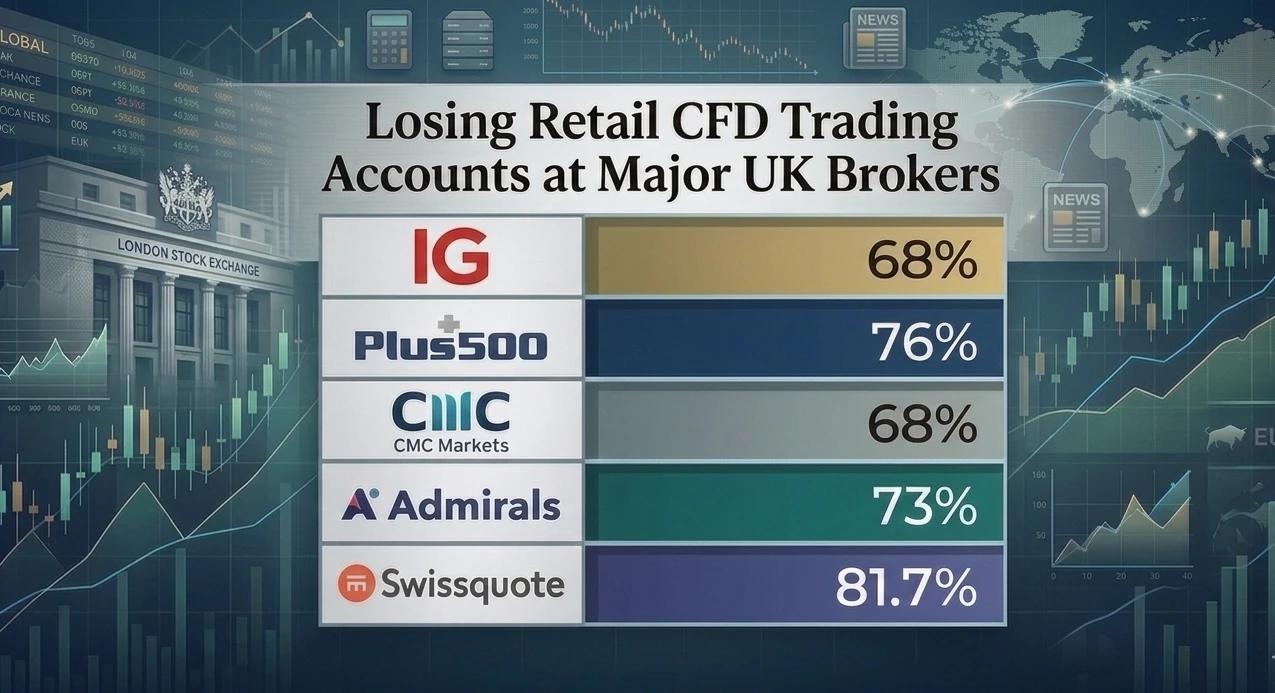
*The percentages reflect the loss rates only at the UK-regulated entities of the brokers.
The fact that these firms are major players listed on the LSE, with market caps ranging from £913.6 million to over £9.4 billion, indicates these high loss percentages are standard even among the most established and well-regulated brokers in the country. Their significant annual revenues, exceeding £4.5 billion in the case of IG Group, showcase the massive scale of the CFD market, despite the small percentage of the population that actually participates in it.
| Broker | LSE Ticker | Market Cap | Revenue (FY 2025) |
|---|---|---|---|
| IG Group | IGG | £4,517.7 million | £1,075.9 million |
| Plus500 | PLUS | £2,871.1 million | $792.4 million (approx. £590.3 million) |
| CMC Markets | CMCX | £913.6 million | £340.1 million |
| Admirals | ADM | £9,440.3 million | £957.9 million |
| Swissquote | 0QLD* | £5,770 million | CHF 720 million (approx. £692.4 million) |
*Swissquote trades on the London Stock Exchange’s International Order Book (IOB), rather than on the Main Market. The company’s primary listing is on the SIX Swiss Exchange.
Sources: Company Financial Reports, Broker Risk Disclaimers, London Stock Exchange
Conclusion
UK retail market participants remain cautious overall as most avoid high-risk products in favour of more traditional assets. While those who do trade crypto or CFDs tend to stay in the market for several years, the high loss rates at major FCA-regulated brokers highlight the significant risks involved. In conclusion, speculative and high-risk trading remains a very small part of the broader investment landscape in the country.