
The tech sector is still feeling the ripple effects of the COVID-19 pandemic, which disrupted job operations across nearly every industry and ultimately led to over a million global job losses since 2021. Since the beginning of 2026, 182,604 tech roles have been cut, and if this pace continues, the year could close with nearly 246,000 job losses, surpassing last year’s 245,000 total.
This latest wave of cuts points to a broader shift in how technology companies operate. What started as a correction from pandemic-era overhiring has now turned into a transformation in how technology companies operate. Companies are increasingly restructuring departments, adopting AI-driven workflows, and optimising staffing levels to improve efficiency and reduce costs.
To provide a clearer picture of this trend, the team at TradingPlatforms reviewed layoffs across the tech sector in 2026. Drawing on data from TrueUp, TechCrunch, and multiple state WARN databases, the team identified the companies that have announced the largest workforce reductions so far this year, offering insight into which firms and regions are being most affected.
Key takeaways
- The United States remains the world leader in technology sector layoffs, having recorded 147,056 job cuts across 205 companies since the beginning of January. This represents roughly 80.53% of the global total of 182,604.
- Oracle is the company with the highest number of layoffs worldwide in 2026, having cut over 29,000 roles as part of a major AI-driven restructuring initiative, while Amazon follows in second place with approximately 17,300 redundancies amid ongoing efficiency measures.
- Cloud, computing and SaaS companies have laid off the most employees so far this year, 42,149 in total, followed by e-commerce firms, which eliminated 23,056 positions, and IT Services with 16,825 recorded layoffs for 2026.
The Countries Most Affected By Tech Layoffs
Tech layoffs in 2026 are heavily concentrated in the United States, where 205 companies have collectively cut 147,056 jobs since the start of the year, by far the largest share globally. The scale of workforce reductions across American firms continues to dwarf other regions, led by major players in enterprise software, e-commerce, social media, and fintech, among other technological sectors. Outside the U.S., Australia ranks a distant second with 4,561 layoffs. Much of the impact stems from large-scale workforce reductions at companies like WiseTech Global, Atlassian, and Telstra, highlighting how a handful of high-profile businesses can significantly shape national figures.
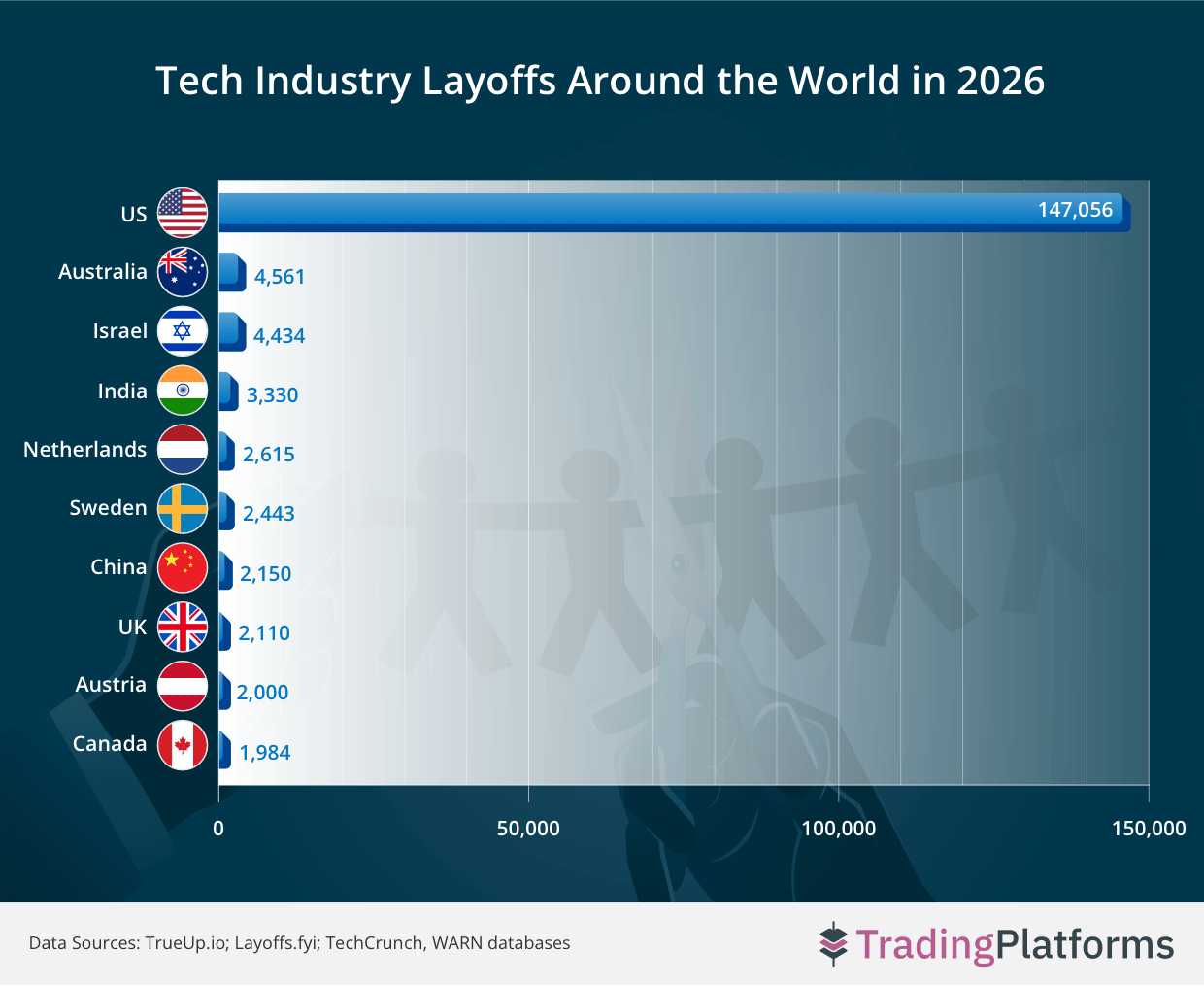
European tech companies have also recorded significant layoffs throughout 2026. The Netherlands (2,615), Sweden (2,443), and the UK (2,110) are the European nations with the most tech sector layoffs, followed by Austria (2.000) and Germany (1,984). As seen in previous months, job cuts across Europe remain closely tied to pressures in semiconductor manufacturing, telecommunications, and IT services, pointing to ongoing structural adjustments across the region’s established tech hubs.
In Asia and the Middle East, workforce reductions are spread across key innovation centres, with Israel (4,434) recording the highest number of layoffs, followed by India (3,330) and China (2,150). The cuts span a wide range of sectors, including AI startups, e-commerce platforms, and cybersecurity firms. A growing share of these layoffs is linked to automation and AI adoption, reinforcing the region’s rapid shift toward more technology-driven operating models.
U.S. tech layoffs are overwhelmingly concentrated in a handful of states
While tech layoffs have affected companies across the United States, the overwhelming majority have been concentrated in a handful of established technology hubs. California, Texas, Washington, and New Jersey-based companies account for 130,479 layoffs combined, representing roughly 88.7% of all U.S. tech job cuts recorded in 2026. Companies headquartered in California alone account for 57,094 layoffs, more than one-third (38.8%) of the national total, reflecting the state’s position as home to Silicon Valley and many of the world’s largest technology companies.
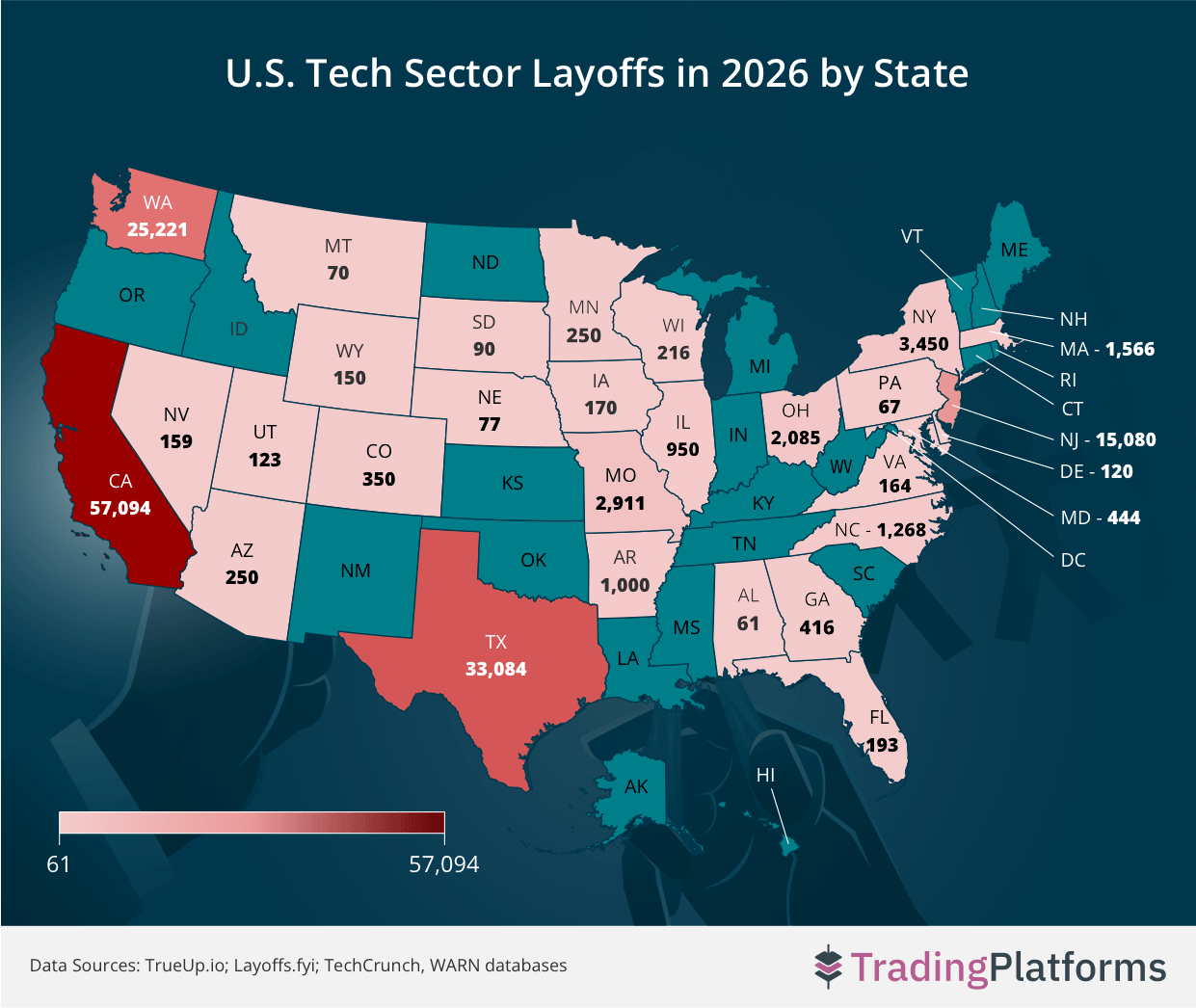
Texas-based companies rank second with 33,084 layoffs, driven primarily by Oracle’s restructuring, which represents nearly 89% of all tech job cuts in the state. Washington follows with 25,221 layoffs, largely attributable to Amazon and Microsoft, while New Jersey’s 15,080 recorded layoffs come entirely from Cognizant’s global workforce reduction.
Oracle and Amazon Lead Global Tech Layoffs in 2026
No company has reduced its workforce more aggressively in 2026 than Oracle, which has cut 29,554 roles across multiple rounds since January. While the company had already begun trimming staff toward the end of 2025, the scale of layoffs escalated sharply in March, when thousands of employees across the United States, India, Canada, and Mexico were dismissed in a sudden wave of cuts. The layoffs are directly tied to Oracle’s rapid expansion into AI infrastructure. Despite reporting a 95% surge in net income to $6.13 billion in Q2 of its fiscal 2026 results, the company is shedding tens of thousands of jobs to redirect capital toward large-scale data centre investments.
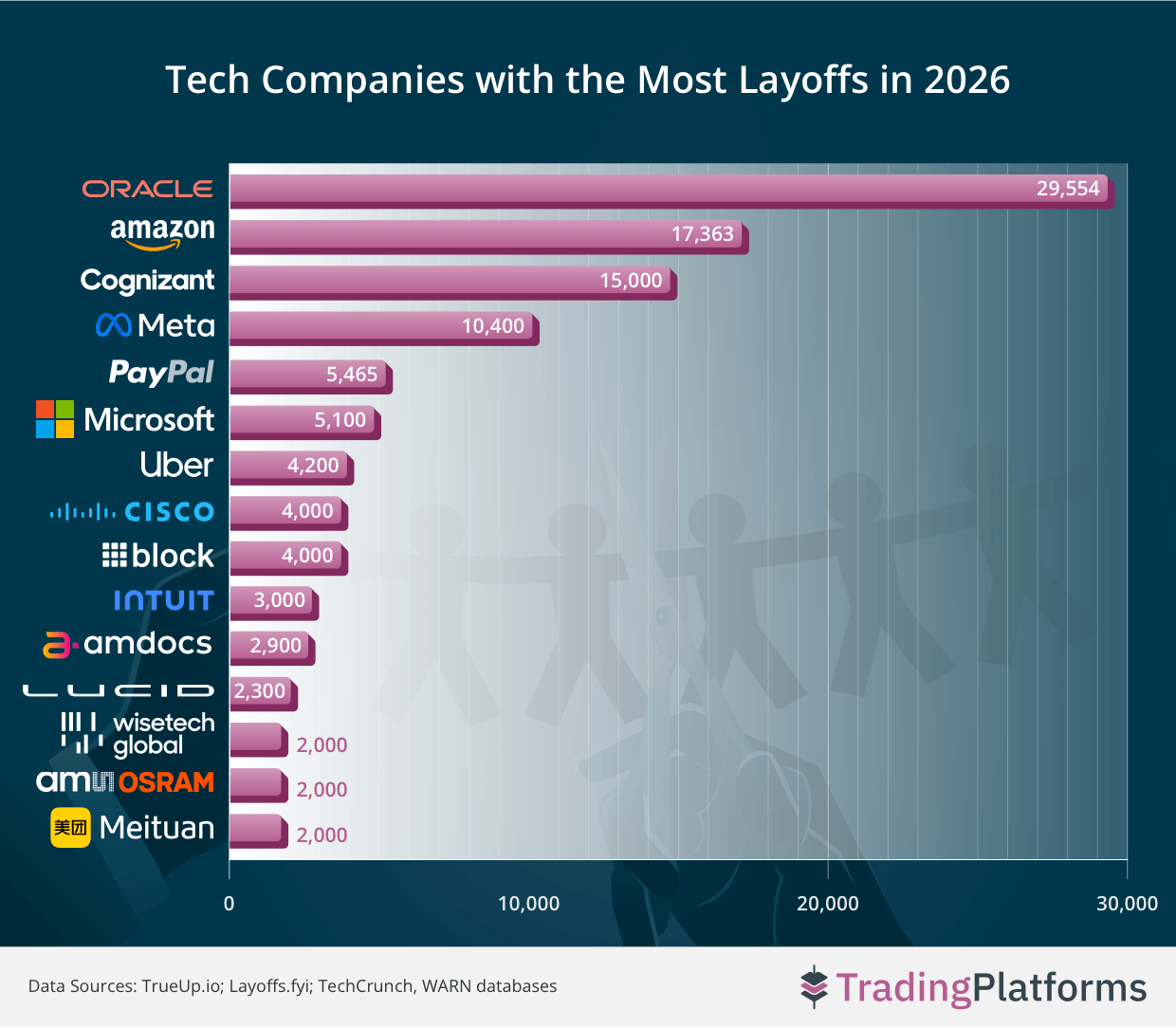
Amazon ranks second in total layoffs this year, with 17,363 jobs cut so far in 2026. This follows an already substantial round of workforce reductions in 2025, including 14,000 redundancies in October alone. The company has positioned the latest cuts as part of a broader push to simplify its organisational structure and improve efficiency. However, they come at a time of strong financial performance, with $716.9 billion in revenue in 2025 and continued heavy spending on AI and cloud infrastructure, including plans for up to $200 billion in capital expenditures this year.
One of the most significant rounds of layoffs this year comes from American information technology consulting and outsourcing company Cognizant. In April, an alleged 4,000 layoffs made headlines, with media reports suggesting the company’s new restructuring initiative, Project Leap, was responsible for these job cuts. In May, however, multiple publications reported that a more realistic figure would actually be between 12,000 and 15,000. Leaked memos from the company pointed to AI as the main reason behind this significant restructuring. Meanwhile, it is believed that most of the affected employees will be those in India; as of the end of 2025, Cognizant employed roughly 357,000, including 250,000 in India.
Meta has also continued to scale back its workforce, eliminating around 10,400 roles in 2026 across several rounds of layoffs. The cuts began in January, when around 1,500 employees were let go from its Reality Labs division, which oversees its virtual and augmented reality products, as Meta shifted resources away from its metaverse ambitions and towards AI-powered wearables. In March, the company cut a further 700 jobs across teams including recruiting, sales, operations and Reality Labs, followed by nearly 200 additional layoffs in Silicon Valley in April. Reuters first reported in March that Meta was preparing sweeping job cuts as its AI spending mounted, later revealing that the initial wave would begin on May 20 and affect roughly 8,000 employees, or about 10% of its global workforce. The restructuring was also outlined in a memo from Meta’s Chief People Officer, Janelle Gale, who said its goal was to help the company operate more efficiently and offset other investments.
Several European firms have also carried out layoff rounds in the thousands. Austria-based ams OSRAM initiated around 2,000 job reductions as part of efforts to improve margins amid softer demand in parts of the semiconductor market. In Sweden, Ericsson announced approximately 1,900 layoffs, largely tied to cost-cutting initiatives in response to slower growth in the global 5G sector. Meanwhile, Dutch chip equipment leader ASML reduced its workforce by about 1,700 roles, focusing primarily on management and technical positions as it restructured internally, despite strong demand for its products.
Cloud & SaaS and E-commerce with the Most Tech Layoffs
Layoffs in 2026 have been heavily concentrated in a small number of industries, with employees in Cloud & SaaS companies emerging as the most affected by a significant margin. The sector accounts for 42,149 job cuts across 19 companies, driven overwhelmingly by Oracle’s sweeping reductions, which alone make up the vast majority of the total. Additional layoffs at Atlassian, Salesforce, and Workday highlight a broader trend across enterprise software, where companies are aggressively restructuring to prioritise AI infrastructure and streamline operations.
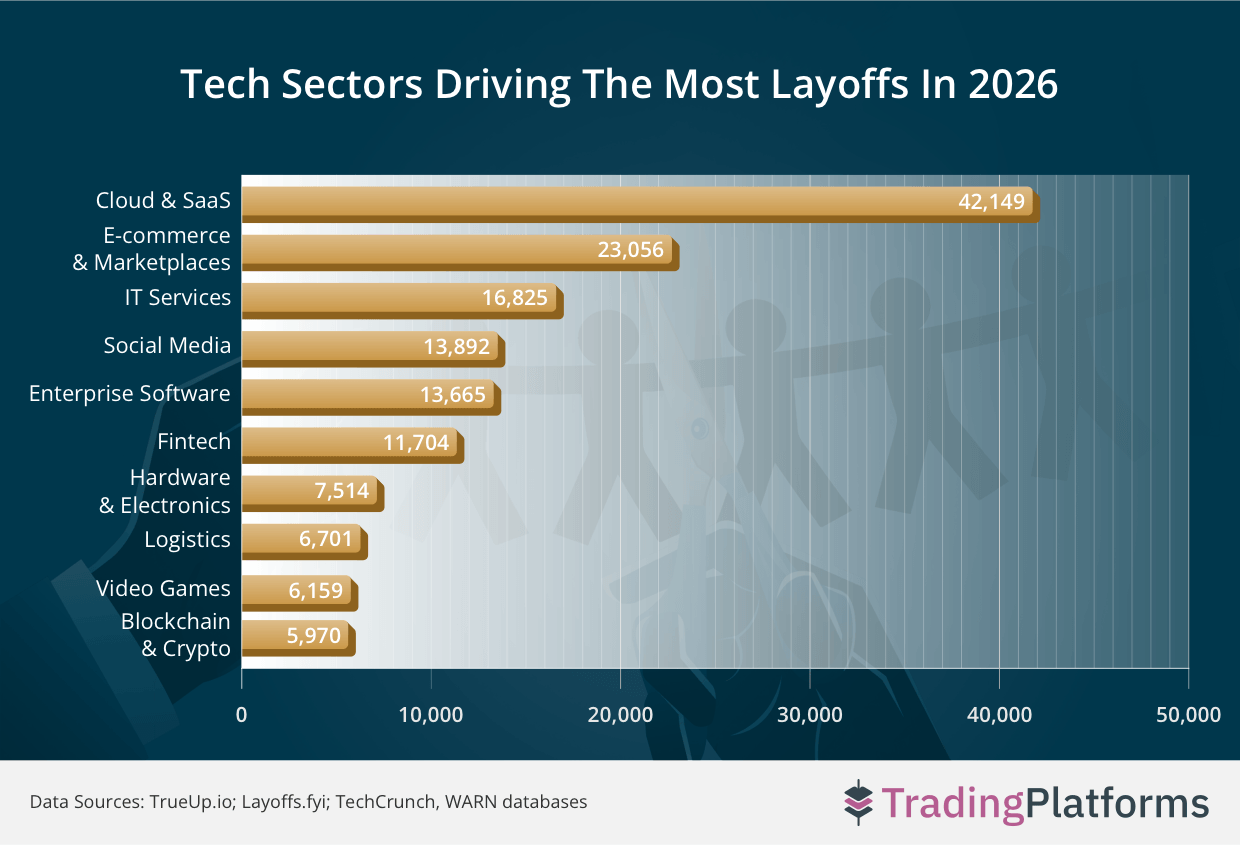
Closely behind, E-commerce & Marketplaces companies have recorded 23,056 layoffs, making it the second-largest affected sector by volume. The vast majority of these cuts are driven by Amazon’s 17,363 job reductions, which account for roughly 75% of the sector total and reflect an ongoing post-pandemic recalibration of its retail, logistics, and corporate workforce. Smaller reductions across companies such as Ocado, eBay, Eventbrite, Flipkart, and Groupon point to a broader global correction in digital commerce, as firms adjust to slower growth in online retail, tighter margins, and shifting consumer demand.
IT Services companies have eliminated 16,825 jobs so far in 2026. The vast majority of these cuts stem from Cognizant, which accounts for 15,000 layoffs, representing nearly 90% of all reductions recorded in the industry. Additional job cuts at firms including Covalen, TCS, TELUS Digital, HCLTech and HGS point to broader pressures facing the global IT services market as clients rein in spending and companies accelerate automation initiatives.
Roughly 13,892 roles have been cut so far in 2026 across seven social media companies, including Meta, Pinterest, and X. Meta accounts for the largest share, with around 10,400 layoffs, largely in an effort to offset massive investment in AI. Snapchat developer, Santa Monica-based Snap Inc., also announced mass layoffs, eliminating roughly 1,000 roles, saying AI would be reducing repetitive tasks. Pinterest has cut 677 employees, focusing on streamlining operations and investing in AI-driven advertising and content tools. X (formerly Twitter) saw about 20 layoffs as part of wider cost-control and organisational adjustments.
Enterprise Software companies have announced approximately 13,665 layoffs across 24 companies in 2026, with the sector bearing the brunt of AI-centered restructuring and cost-cutting efforts this year. Cisco accounts for the largest share, cutting 4,000 jobs as it continues shifting resources towards AI, cybersecurity and networking infrastructure. Israeli-founded telecom and software services provider Amdocs has eliminated 2,900 roles as part of a major restructuring programme aimed at improving profitability and accelerating AI adoption, while Autodesk has cut 1,000 positions as it increases its own AI investment.
Fintech companies have recorded 11,704 layoffs so far in 2026, driven primarily by large-scale reductions at major payments and financial software providers. PayPal and Intuit together account for the majority of the sector’s total headcount reductions. Additional cuts across firms such as Bill, StoneCo, Robinhood, and Blackhawk Network highlight broader pressure on fintech platforms as companies increasingly shift toward AI-driven fraud detection, risk modelling, and customer automation. Smaller reductions at firms including Fiserv, Credit Karma, Remitly, and Monzo further show a sector-wide recalibration, as fintech companies prioritise profitability and efficiency over rapid expansion in a more competitive and capital-constrained environment.
Video game developers saw 6,159 roles cut across several high-profile studios in 2026, highlighting pressures from shifting player engagement, project cancellations and broader industry realignment. Epic Games led the round of reductions with over 1,000 layoffs, citing a downturn in engagement with its flagship Fortnite franchise and the need to rebalance costs amid weak growth. At Ubisoft, multiple waves of layoffs have continued into 2026 as part of a wider global restructuring, which has included cancelling projects and reorganising studios such as Red Storm Entertainment and outlets in Massive Entertainment and Ubisoft Stockholm. Bungie, the company behind the Halo and Destiny franchises, recently announced that it would be laying off 400 employees beginning in the summer of 2026.
More than Half of Global Tech Layoffs In 2026 Are AI-Related
Artificial intelligence and automation have emerged as major factors in tech workforce reductions in 2026. As of early April, 96,364 tech jobs have been cut worldwide due to AI-linked restructuring, accounting for more than half of all global layoffs reported so far this year.
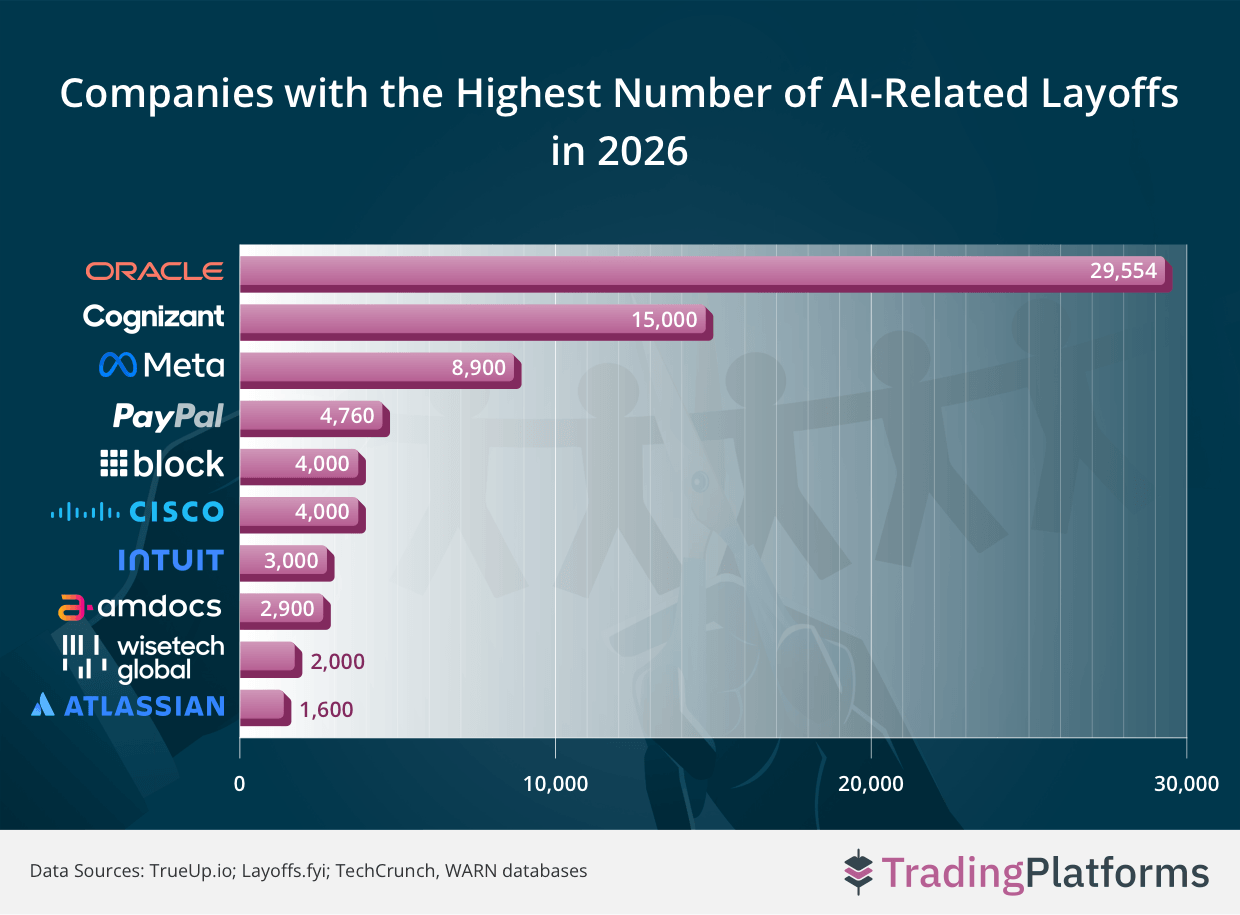
Oracle stands at the centre of this trend, with all 29,554 of its layoffs in 2026 effectively tied to AI. However, these cuts are not the result of AI systems directly replacing workers at scale. Instead, they stem from the company’s aggressive push to fund its expanding AI infrastructure ambitions. In practice, this creates a double impact: employees are being laid off not because AI is already doing their jobs, but because the company is cutting costs to finance the buildout of the very systems that will eventually do so.
Cognizant is reportedly preparing one of the largest AI-related restructurings in the IT services sector, with between 12,000 and 15,000 jobs potentially at risk under its new “Project Leap” programme. The company says the initiative is designed to shift its business toward an AI-led operating model, reduce management layers, and automate more traditional IT and support functions. Most of the cuts are expected to affect India, where the majority of Cognizant’s workforce is based, while the firm has set aside up to $320 million for restructuring and severance costs. At the same time, Cognizant argues the transition is not purely about downsizing: the company also plans to hire tens of thousands of junior employees with AI-related skills, reflecting a broader shift toward leaner, AI-augmented teams rather than large legacy workforces.
As mentioned above, a large portion of this year’s layoffs at Meta is also due to AI; it is not about artificial intelligence replacing human workers, however, but rather cutting payroll expenses. The company announced plans to cut a further 8,000 jobs in 2026 (about 10% of its workforce), as it redirects spending toward artificial intelligence infrastructure, data centers, and AI-powered products. Executives said the layoffs are part of a broader efficiency push designed to offset soaring AI investment costs, with Meta expected to spend well over $100 billion on AI-related infrastructure this year alone.
In the fintech sector, PayPal is undergoing one of the largest AI-linked restructurings this year with plans to cut roughly 20% of its workforce – around 4,700 to 4,800 jobs – over the next two to three years. The layoffs are part of a broader push by new CEO Enrique Lores to “become a technology company again”, with the firm aggressively adopting artificial intelligence across software development, customer support, operations, and risk management.
The company says AI-driven automation and organisational simplification could generate at least $1.5 billion in savings, while also helping smaller teams work more efficiently. PayPal is simultaneously modernising its infrastructure, shifting toward cloud-native systems and restructuring the business into three major divisions focused on payments, consumer finance, and crypto services. Investor reaction has been mixed: while management argues the changes are necessary to regain competitiveness, PayPal’s stock dropped sharply following the announcement, a result of growing concerns about slowing growth and the human cost of AI-driven restructuring.
San Francisco-based cloud services and web security provider Cloudflare also plans to cut more than 1,100 jobs, which is roughly 20% of its global workforce. The company said the layoffs were tied directly to its shift toward an “agentic AI-first operating model,” with internal usage of AI tools reportedly surging by over 600% in just three months. According to executives, AI is now heavily used across departments ranging from engineering and HR to finance and marketing, fundamentally changing how work is done inside the company.
At the same time, the company reported stronger-than-expected quarterly revenue growth of nearly 34%, showing how companies are increasingly using AI not simply to cut costs, but to redesign operations around automation and productivity gains. The restructuring is expected to cost the company up to $150 million, mostly tied to severance and employee-related expenses. The decision also sparked debate because only months earlier, Cloudflare had publicly promoted expanded internship hiring, arguing that AI should augment workers rather than replace them. Now, the company has become one of the defining symbols of how rapidly artificial intelligence is beginning to transform and eliminate white-collar jobs across the global tech industry.
Block represents one of the clearest examples of AI directly influencing layoff decisions in 2026, with 4,000 roles eliminated. Unlike many companies that frame cuts around efficiency or restructuring, Block was unusually explicit in its reasoning, with leadership stating that artificial intelligence could now take over a significant portion of the work previously handled by those employees. This positions the company as an early indicator of how others may approach workforce reductions, where AI is not just a future investment but an immediate replacement for certain roles.
Other tech companies with significant AI-driven workforce reductions include WiseTech Global (2,000 layoffs) and Atlassian (1,600), which cite their cuts as part of a shift toward AI-focused operations, while Intuit (3,000), Livspace (1,000), eBay (800), and Pinterest (675) link reductions to automation, efficiency, or AI-enabled product development. Even firms in more traditional sectors, like telecom Telstra (650) and Internet provider ANGI Homeservices (350), are adopting AI in operations, driving layoffs as part of broader optimisation.
Together, these figures underline a shift in workforce strategy: AI is no longer just a future investment but a current driver of organisational restructuring, hiring decisions, and cost-cutting across the tech industry in 2026.
Looking Ahead: The State of the Tech Workforce
The tech industry continues to absorb the lingering effects of the COVID-19 pandemic, which has reshaped the sector and led to over a million job losses globally since 2021. By late September 2026, over 182,604 tech sector layoffs have been recorded worldwide, and if current trends persist, the year could end with roughly 245,943 job cuts, surpassing 2025’s total of 245,000. This is indicative of how sharply the industry is adjusting to both structural changes and new operational priorities.
Artificial intelligence has emerged as a key driver of this shift. Roughly 53% of all global layoffs have been linked to AI-driven restructuring, reflecting a stark departure from previous mass layoff waves. The impact is no longer limited to support or operational roles; engineering teams, senior leadership, and even entire product divisions are being reorganised around the expectation that AI can take on an increasing share of work.
Yet the reality behind these figures is more nuanced. While companies present AI as a driver of efficiency, relatively few have fully operational AI systems capable of taking over significant workloads, and even fewer are using them at scale. Many layoffs appear to be pre-emptive cost-cutting measures to fund AI infrastructure rather than the direct result of automation. This suggests that some AI-related job losses may eventually be offset by rehiring, often in lower-wage regions, once implementation catches up with expectations.
At the same time, the hiring landscape shows a targeted shift rather than a total contraction. Demand for AI and machine learning specialists continues to grow, even as overall tech employment declines, signalling a sector consolidating around highly specialised skills. Whether this transformation will ultimately create as many opportunities as it has eliminated remains uncertain, and 2026 will likely be the year when the balance between disruption and opportunity becomes clearer.
Methodology
For this analysis, the team at TradingPlatforms collected data on all reported tech company layoffs from the start of 2026. The primary source was the IT job portal TrueUp.io, supplemented with additional information from TechCrunch, Layoffs.fyi, and multiple WARN databases in the United States. These sources provide publicly available announcements, offering advance notice in cases of mass layoffs or plant closures, in line with the requirements of the U.S. Worker Adjustment and Retraining Notification (WARN) Act.
Layoff totals were first compiled at the company level to determine the full scope of workforce reductions per firm. Companies were then categorised by country of headquarters to map the geographic distribution of job losses. To identify the most significant impacts, firms were ranked based on the number of layoffs, while countries were ranked by the combined number of job cuts reported by companies headquartered within their borders. This approach allowed for a clear view of both company-level and regional trends in 2026’s tech workforce reductions.