
The tech sector is still feeling the ripple effects of the COVID-19 pandemic, which reshaped operations and led to over a million global job losses since 2021. In just the first three months of 2026, a total of 80,117 roles have been cut, and if this pace continues, the year could close with roughly 301,471 job losses, eclipsing the 245,000 layoffs seen in 2025. These figures highlight the scale of adjustment underway as companies respond to both structural changes and new operational priorities.
This latest wave of cuts builds on several years of post-pandemic adjustment, during which the global tech workforce shrank by more than a million positions. What started as a correction from pandemic-era hiring booms has now turned into a deeper transformation in how technology companies operate. Companies are increasingly restructuring departments, adopting AI-driven workflows, and optimising staffing levels to improve efficiency and reduce costs.
To provide a clearer picture of this trend, the team at TradingPlatforms reviewed layoffs across the tech sector in 2026. Drawing on data from TrueUp, TechCrunch, and multiple state WARN databases, the team identified the companies that have announced the largest workforce reductions so far this year, offering insight into which firms and regions are being most affected.
Key takeaways
- The United States remains the world leader in technology sector layoffs, having recorded 61,650 job cuts across 62 companies since the beginning of January. This represents roughly 77% of the global total of 80,117.
- Oracle is the company with the highest number of layoffs worldwide in 2026, having cut over 25,000 roles as part of a major AI-driven restructuring initiative, while Amazon follows in second place with approximately 16,000 redundancies amid ongoing efficiency measures.
- Cloud, computing, and SaaS companies have laid off the most employees so far this year, 28,000 in total, followed by e-commerce firms, which eliminated 19,000 positions.
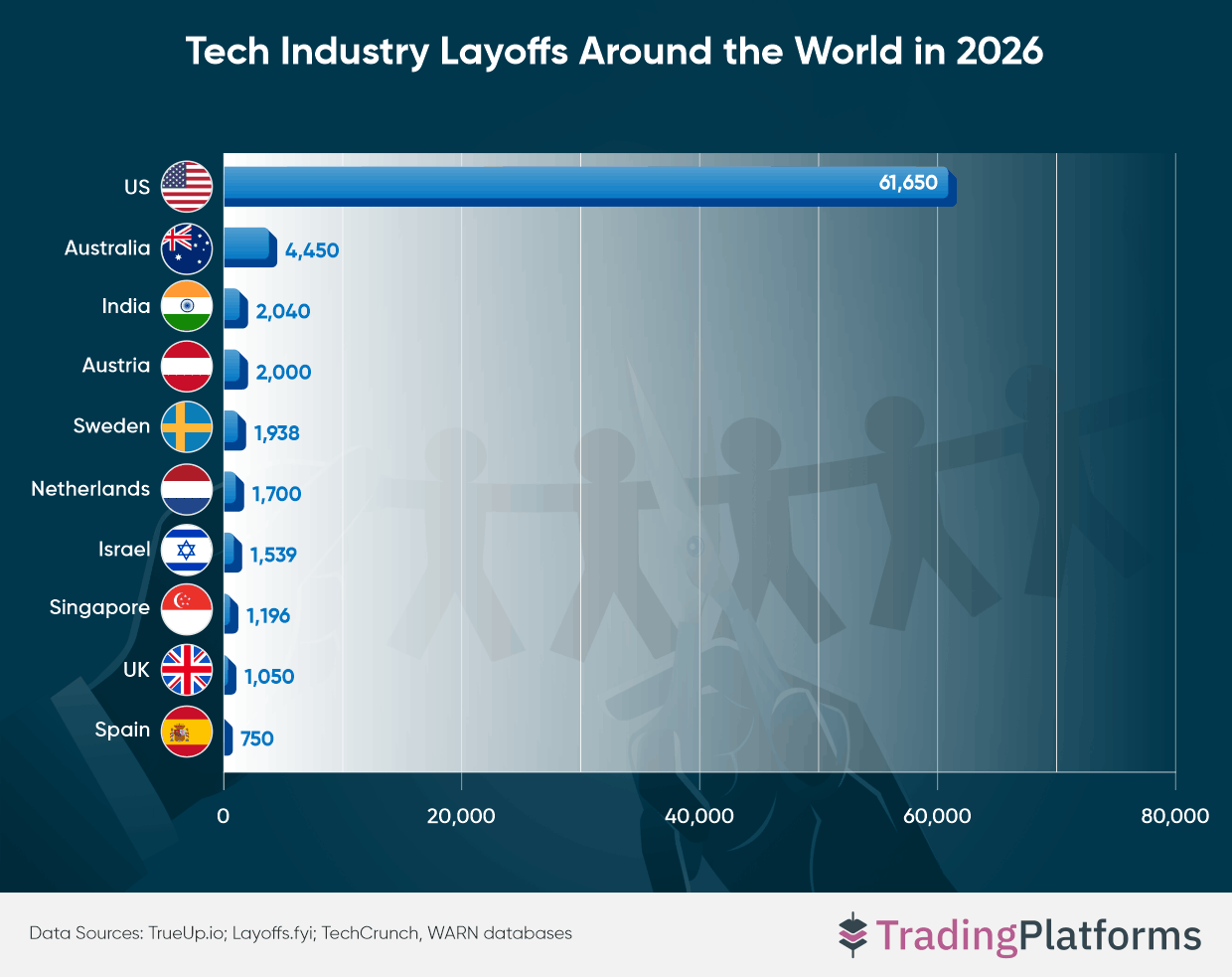
Tech layoffs in 2026 are heavily concentrated in the United States, where 62 companies have accounted for 61,650 job cuts since the start of the year, by far the largest share globally. The scale of workforce reductions across American firms continues to dwarf other regions, led by major players in enterprise software, e-commerce, social media, and fintech, among other technological sectors. Outside the U.S., Australia ranks a distant second with 4,450 layoffs. Much of the impact stems from large-scale workforce reductions at companies like WiseTech Global, Atlassian, and Telstra, highlighting how a handful of high-profile businesses can significantly shape national figures.
Across Europe, layoffs are more fragmented but still significant. Austria (2,000), Sweden (1,938), and the Netherlands (1,700) are the European nations with the most tech sector layoffs, followed by the UK (1,050) and Spain (750). As seen in previous months, job cuts across Europe remain closely tied to pressures in semiconductor manufacturing, telecommunications, and IT services, pointing to ongoing structural adjustments across the region’s established tech hubs.
In Asia, workforce reductions are spread across key innovation centres, with India (2,040) recording the highest number of layoffs, followed by Israel (1,539) and Singapore (1,196). The cuts span a wide range of sectors, including AI startups, e-commerce platforms, and cybersecurity firms. A growing share of these layoffs is linked to automation and AI adoption, particularly in Israel and Singapore, reinforcing the region’s rapid shift toward more technology-driven operating models.
Oracle and Amazon Lead Global Tech Layoffs in 2026
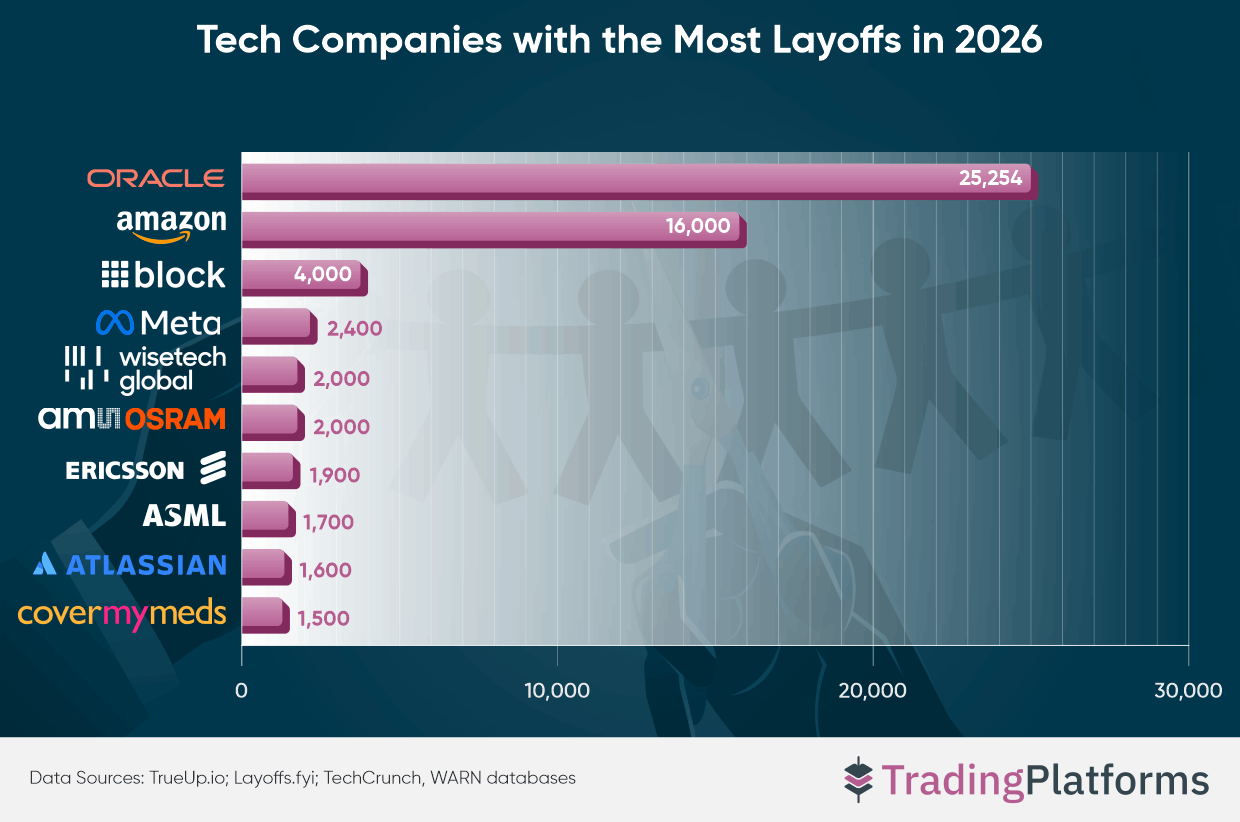
No company has reduced its workforce more aggressively in 2026 than Oracle, which has cut 25,254 roles across multiple rounds since January. While the company had already begun trimming staff toward the end of 2025, the scale of layoffs escalated sharply in March, when thousands of employees across the United States, India, Canada, and Mexico were dismissed in a sudden wave of cuts. The layoffs are directly tied to Oracle’s rapid expansion into AI infrastructure. Despite reporting a 95% surge in net income to $6.13 billion in Q2 of its fiscal 2026 results, the company is shedding tens of thousands of jobs to redirect capital toward large-scale data centre investments.
Amazon ranks second in total layoffs this year, with 16,000 jobs cut so far in 2026. This follows an already substantial round of workforce reductions in 2025, including 14,000 redundancies in October alone. The company has positioned the latest cuts as part of a broader push to simplify its organisational structure and improve efficiency. However, they come at a time of strong financial performance, with $716.9 billion in revenue in 2025 and continued heavy spending on AI and cloud infrastructure, including plans for up to $200 billion in capital expenditures this year.
Meta has also continued to scale back its workforce, eliminating around 2,400 roles in 2026. Much of the impact has been concentrated within its Reality Labs division, which oversees virtual reality and metaverse-related products. The company is increasingly shifting its focus away from high-cost experimental projects and toward artificial intelligence, reallocating resources to areas with clearer commercial potential while maintaining longer-term ambitions in augmented reality.
Several European firms have also carried out layoff rounds in the thousands. Austria-based ams OSRAM initiated around 2,000 job reductions as part of efforts to improve margins amid softer demand in parts of the semiconductor market. In Sweden, Ericsson announced approximately 1,900 layoffs, largely tied to cost-cutting initiatives in response to slower growth in the global 5G sector. Meanwhile, Dutch chip equipment leader ASML reduced its workforce by about 1,700 roles, focusing primarily on management and technical positions as it restructured internally, despite strong demand for its products.
In the healthcare technology space, CoverMyMeds confirmed 1,500 job cuts as part of a wider reorganisation effort led by its parent company. The move reflects shifting priorities and a scaling back of operations, making it one of the more notable workforce reductions outside of core Big Tech and semiconductor sectors this year.
Cloud & SaaS and E-commerce Account for Over Half of Global Tech Layoffs
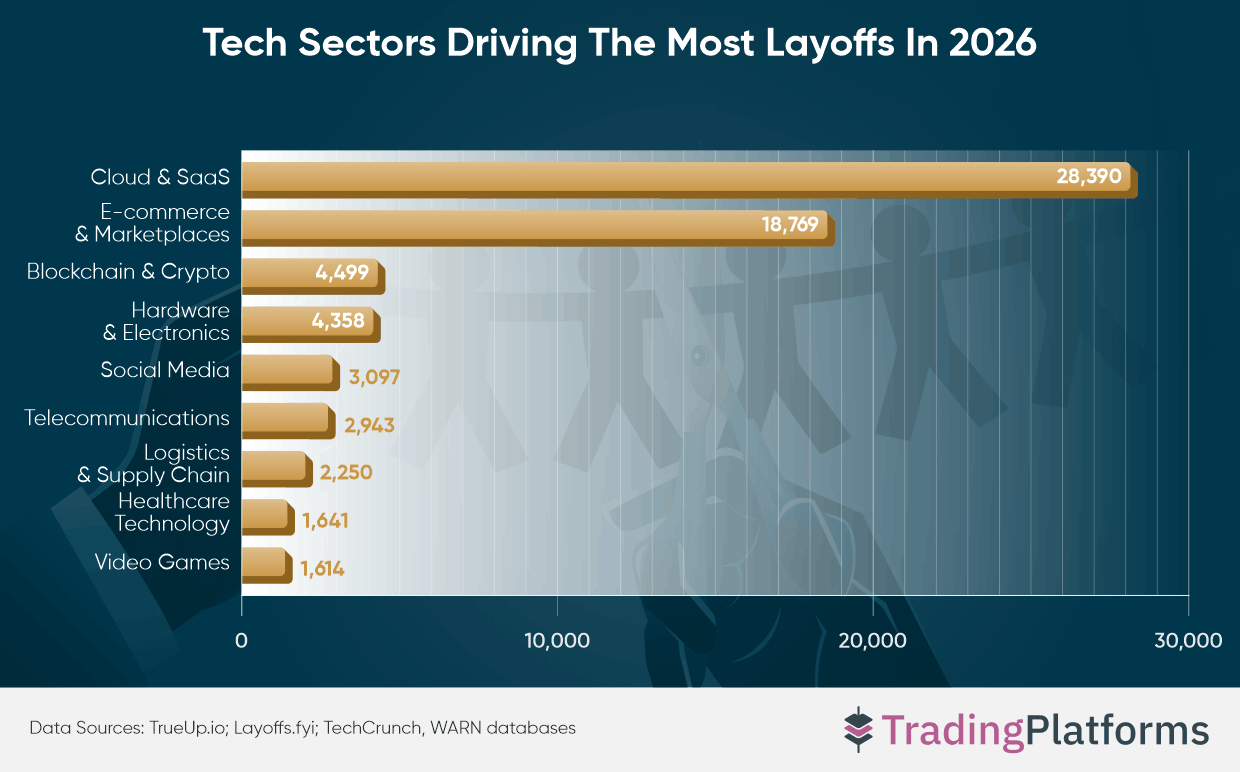
Layoffs in 2026 have been heavily concentrated in a small number of industries, with employees in Cloud & SaaS companies emerging as the most affected by a significant margin. The sector accounts for 28,390 job cuts across just six companies, driven overwhelmingly by Oracle’s sweeping reductions, which alone make up the vast majority of the total. Additional layoffs at Atlassian, Salesforce, and Workday highlight a broader trend across enterprise software, where companies are aggressively restructuring to prioritise AI infrastructure and streamline operations. Closely behind, E-commerce & Marketplaces companies have recorded 18,769 layoffs, largely dominated by Amazon’s 16,000 job cuts, with smaller reductions at companies such as eBay, Ocado, and Flipkart reflecting continued post-pandemic correction and a shift toward automation-driven efficiency.
Outside of the two leading sectors, in Blockchain & Crypto, a total of 9 companies have carried out 4,499 layoffs, with the bulk coming from Jack Dorsey’s Block Inc., reflecting ongoing market volatility, regulatory uncertainty, and a more cautious investment climate following several high-profile crypto collapses in recent years. Crypto companies have been forced to streamline operations, reduce overhead, and focus on sustainable revenue models amid fluctuating demand and tighter capital availability.
Hardware & Electronics recorded 4,358 job cuts, largely driven by restructuring at major semiconductor and electronics firms such as ams OSRAM and ASML. While long-term demand for chips and hardware remains strong, these reductions are part of broader cost-efficiency measures, with companies realigning production, consolidating teams, and refocusing on high-margin segments to maintain profitability in a highly competitive and cyclical market.
Roughly 3,100 roles have been cut so far in 2026 across three major social media companies: Meta, Pinterest, and X. Meta accounts for the largest share, with around 2,400 layoffs, largely in teams being realigned to prioritise AI and efficiency initiatives, including Reality Labs. Pinterest has cut 677 employees, focusing on streamlining operations and investing in AI-driven advertising and content tools. X (formerly Twitter) saw about 20 layoffs as part of wider cost-control and organisational adjustments.
Video game developers saw 1,614 roles cut across several high-profile studios in 2026, highlighting pressures from shifting player engagement, project cancellations and broader industry realignment. Epic Games led the round of reductions with over 1,000 layoffs, citing a downturn in engagement with its flagship Fortnite franchise and the need to rebalance costs amid weak growth. At Ubisoft, multiple waves of layoffs have continued into 2026 as part of a wider global restructuring, which has included cancelling projects and reorganising studios such as Red Storm Entertainment and outlets in Massive Entertainment and Ubisoft Stockholm. Other cuts were recorded by Tencent, Riot Games, Crystal Dynamics and Embracer Group, further reflecting a difficult period for the sector as studios balance ambition with profitability.
Half Of Global Tech Layoffs In 2026 Are AI-Related
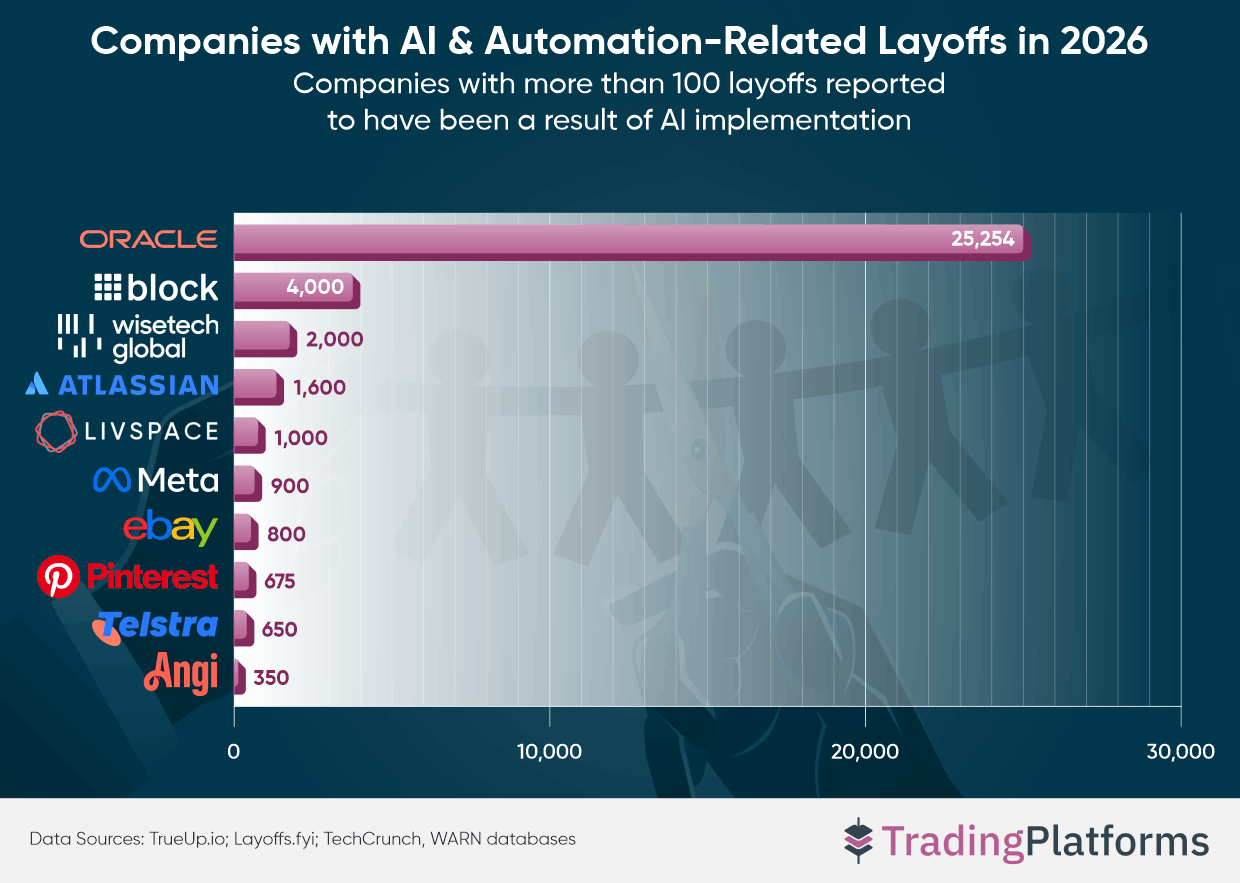
Artificial intelligence and automation have emerged as a major factor in tech workforce reductions in 2026. As of early April, 38,088 tech jobs have been cut worldwide due to AI-linked restructuring, accounting for nearly half of all global layoffs reported so far this year.
Oracle stands at the centre of this trend, with all 25,254 of its layoffs in 2026 effectively tied to AI. However, these cuts are not the result of AI systems directly replacing workers at scale. Instead, they stem from the company’s aggressive push to fund its expanding AI infrastructure ambitions. In practice, this creates a double impact: employees are being laid off not because AI is already doing their jobs, but because the company is cutting costs to finance the buildout of the very systems that will eventually do so.
Block represents one of the clearest examples of AI directly influencing layoff decisions in 2026, with 4,000 roles eliminated. Unlike many companies that frame cuts around efficiency or restructuring, Block was unusually explicit in its reasoning, with leadership stating that artificial intelligence could now take over a significant portion of the work previously handled by those employees. This positions the company as an early indicator of how others may approach workforce reductions, where AI is not just a future investment, but an immediate replacement for certain roles.
Other tech companies with significant AI-driven workforce reductions include WiseTech Global (2,000 layoffs) and Atlassian (1,600), which cite their cuts as part of a shift toward AI-focused operations, while Livspace (1,000), Meta (900), eBay (800), and Pinterest (675) link reductions to automation, efficiency, or AI-enabled product development. Even firms in more traditional sectors, like telecom Telstra (650) and Internet provider ANGI Homeservices (350), are adopting AI in operations, driving layoffs as part of broader optimisation.
Together, these figures underline a shift in workforce strategy: AI is no longer just a future investment but a current driver of organisational restructuring, hiring decisions, and cost-cutting across the tech industry in 2026.
Looking Ahead: The State of the Tech Workforce
The tech industry continues to absorb the lingering effects of the COVID-19 pandemic, which has reshaped the sector and led to over a million job losses globally since 2021. The first three months of 2026 alone have seen 80,117 layoffs, and if current trends persist, the year could end with roughly 301,471 job cuts, surpassing 2025’s total of 245,000. This is indicative of how sharply the industry is adjusting to both structural changes and new operational priorities.
Artificial intelligence has emerged as a key driver of this shift. By early April 2026, nearly half of all global layoffs have been linked to AI-driven restructuring, reflecting a stark departure from previous mass layoff waves. The impact is no longer limited to support or operational roles; engineering teams, senior leadership, and even entire product divisions are being reorganised around the expectation that AI can take on an increasing share of work.
Yet the reality behind these figures is more nuanced. While companies present AI as a driver of efficiency, relatively few have fully operational AI systems capable of taking over significant workloads, and even fewer are using them at scale. Many layoffs appear to be pre-emptive cost-cutting measures to fund AI infrastructure rather than the direct result of automation. This suggests that some AI-related job losses may eventually be offset by rehiring, often in lower-wage regions, once implementation catches up with expectations.
At the same time, the hiring landscape shows a targeted shift rather than a total contraction. Demand for AI and machine learning specialists continues to grow, even as overall tech employment declines, signalling a sector consolidating around highly specialised skills. Whether this transformation will ultimately create as many opportunities as it has eliminated remains uncertain, and 2026 will likely be the year when the balance between disruption and opportunity becomes clearer.
Methodology
For this analysis, the team at TradingPlatforms collected data on all reported tech company layoffs from the start of 2026. The primary source was the IT job portal TrueUp.io, supplemented with additional information from TechCrunch, Layoffs.fyi, and multiple WARN databases in the United States. These sources provide publicly available announcements, offering advance notice in cases of mass layoffs or plant closures, in line with the requirements of the U.S. Worker Adjustment and Retraining Notification (WARN) Act.
Layoff totals were first compiled at the company level to determine the full scope of workforce reductions per firm. Companies were then categorised by country of headquarters to map the geographic distribution of job losses. To identify the most significant impacts, firms were ranked based on the number of layoffs, while countries were ranked by the combined number of job cuts reported by companies headquartered within their borders. This approach allowed for a clear view of both company-level and regional trends in 2026’s tech workforce reductions.